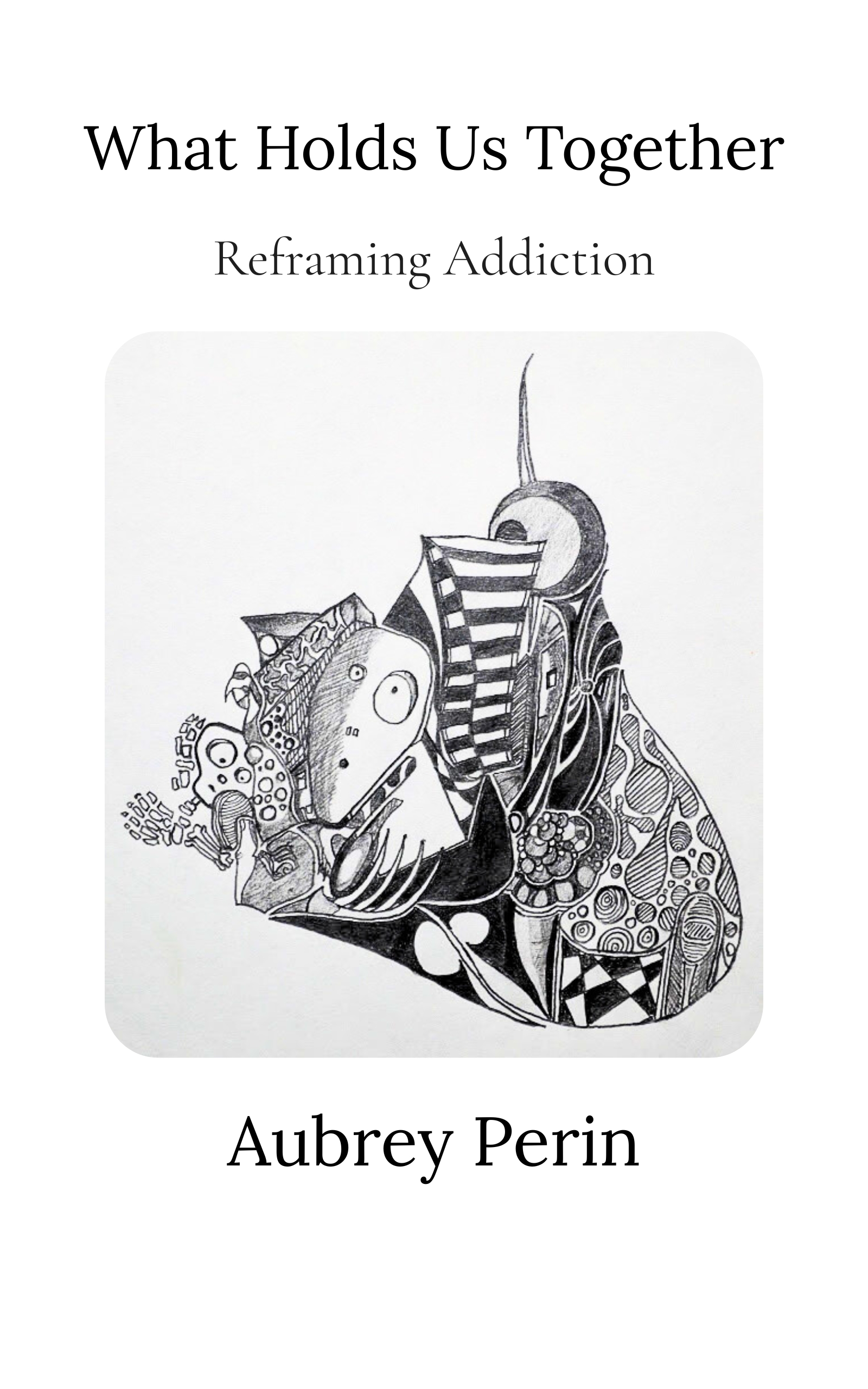
You don’t have to be ready. You just have to be here.
Four passages from What Holds Us Together, the questions the book asks after them, and a private place to answer. No program, no assessment, no progress bar. Read one door or all four, at whatever pace feels safe.
“Addiction is not chaos, but coherence — a strategy to feel safe when nothing else holds.”
From the introduction
There’s no right door. Each one opens a passage from the book, exactly as it appears on the page, and the question the book asks you to sit with afterward. You can open all of them or none of them.
Vignette · Chapter 1 · What Addiction Really Is
The Porch Light
Every night before bed, he checked the porch light. Even when it wasn’t his job. Even when it had already been checked. Even when he lived alone and there was no one left to forget.
It wasn’t about safety, not really. The neighborhood was quiet. The motion sensor worked fine. But still, he’d walk to the front door, peer out through the side window, and make sure the light was on.
At first, it was a habit — one passed down from his father, who always said a lit porch made a home feel “ready.” But after the divorce, after the house got quieter, the ritual changed. It stopped being about the outside. It became about him.
Because when the porch was dark, the house felt abandoned.
And when the light was on, it meant someone was still trying.
Some nights, he’d turn it off just to turn it back on again — a little ceremony to reset the feeling that he had lost control of the day.
On nights when the loneliness pressed in, he’d linger by the door, looking at the light like it was proof that he was still here. Still holding. Still worth illuminating.
The vignette runs another page, to the night the bulb burns out. Chapter 1 opens on it.
What moments — however small — help you feel like the day still belongs to you?
And if one of them disappeared… would anyone know it mattered?
Vignette · Chapter 3 · The Game of Addiction
The After-Party
He used to drink with friends. Loud bars, crowded porches, tailgates before games. It felt electric — chaotic in the best way. Everyone laughing too hard. Music always too loud. He was the one who brought the bottle, poured the shots, toasted nothing at all. They called him fun. Reliable. The guy who always had a plan for Friday night.
In those days, drinking meant people. It meant rhythm. It meant knowing who he was — the guy who could take the edge off the room and hold it there, just long enough for everyone to feel okay. No one asked how he was doing. They didn’t have to. He looked like he was thriving.
Eventually, people changed. They settled down. Got jobs with early mornings. Started skipping the bar, started slowing down. But he didn’t. The party got smaller. First five people. Then two. Then none.
At first, it didn’t feel different. The same brand. The same pour. The same playlist. But something shifted. There was no one left to laugh with. No one to mirror his energy. The rhythm was still there — but the connection was gone.
He stopped pouring for others.
And started measuring only for himself.
What the drink becomes after that — and what it costs him — is the rest of Chapter 3.
Sometimes the behavior doesn’t change, but everything around it does. You’re still following the same steps, and the meaning is gone.
If you’re noticing that the same pattern no longer brings the same relief, that’s not failure. That’s awareness.
Vignette · Chapter 8 · Safety Before Sobriety
A Different Kind of Meeting
He didn’t want to call. But the edge was creeping in again — that slow hum in his chest, the feeling that something was slipping. He hadn’t used. Not yet. But the world felt too loud again, and he couldn’t quite remember what he was supposed to do with himself when it did.
He texted instead. Can we meet? I think I need structure.
The response came quickly. Absolutely. You pick the place.
That part always threw him. He wasn’t used to being the one who chose. For most of his life, help had come with terms. Rules. Programs. Expectations. Even in recovery, it sometimes felt like if he wasn’t following the script, he was wasting someone’s time.
But when his sponsor arrived, they didn’t look rushed. Or concerned. Or calculating his progress in quiet disappointment. They just smiled and said, “Thanks for meeting me. You doing okay?”
The place was crowded. Music in the background. Too many conversations overlapping. A table behind them laughed loudly — not at him, but his body didn’t know the difference. His shoulders tensed.
His sponsor noticed. Didn’t say anything at first. Just waited a few minutes. Let the moment breathe. Then, gently: “Hey… would it help to ask for a quieter table?”
He looked up. “I don’t want to be a hassle.”
“You’re not,” they said. No hesitation. “You’re learning to listen to yourself. That’s not a hassle. That’s recovery.”
They move to the back booth, and the chapter builds a definition of safety out of that one small request.
What does safety look like for you? Not the kind others expected you to settle for. Not the kind that came with silence, performance, or earning your worth. The kind your body would recognize as real.
Later, in Chapter 10 · Ritual That Restores
“Then one morning — mid-winter, light barely cracking the horizon — he made a second cup of tea. Slowly. On purpose. No goal. No box to check. It was five quiet minutes. And for reasons he couldn’t quite explain, he cried the whole time.”
Part IV · For the Witness
You are the tether
Healing doesn’t happen in isolation. And neither does collapse.
For every person in crisis, there is someone watching. A parent. A partner. A friend. A child. A therapist. A stranger in the right place at the right time. Sometimes they stay. Sometimes they flee. Sometimes they try so hard to help that they forget to hold.
This part of the book is for them. For the people who want to show up but don’t know how. For the people who stayed and got it wrong. For the people who are trying to love someone through something that doesn’t follow logic or timelines.
You don’t have to fix them. You don’t have to say the perfect thing. You just have to stop asking them to be okay before they’re allowed to be loved.
Witnessing isn’t a passive act. It’s an offering. A quiet bravery. A promise that says: You don’t have to disappear in order to be safe with me.
Five things we say in the name of comfort
The chapter works through the phrases most of us reach for when someone is coming undone. Open one to see why it lands the way it does.
Meant to offer perspective. To someone in collapse it bypasses the present in favour of imagined gratitude, and says: your pain is only valid if someone else has it worse.
In real distress this can feel like gaslighting. It suggests suffering is part of a design — a comfort only when someone is ready to hear it, and devastating when they’re not. It usually relieves the speaker, not the person in pain.
It sounds uplifting and lands as an expectation. Being told you’re strong while you feel like you’re breaking reads as an instruction to hide the breaking.
Kindness with the weight handed back. Someone in collapse usually can’t name what they need. They need presence, not permission to reach out.
Collapse isn’t an attitude problem. It’s nervous system depletion and years of held pain surfacing. What this often really asks is: please don’t make me feel this too.
Try instead
“I’m here.”
“You don’t have to explain it.”
“I’m not going anywhere.”
“You don’t need to be okay for me to care.”
“Can I sit with you in this?”
The chapter goes on to what to do when staying starts to cost you more than you have.
What part of their pain is touching something in me?
Am I trying to help them, or am I trying to silence my own discomfort?
What would it mean to offer support without needing to be the solution?
The framework
Five ideas the book is built on
None of them require you to agree. They’re offered as another way to look at something you may already have been told a hundred stories about.
Addiction as coherence
“Addiction is not chaos, but coherence — a strategy to feel safe when nothing else holds.”
Most models start by asking what went wrong. This one starts by asking what the behavior was holding together. When the world stops making sense and no one is helping you carry it, you build something that does: a routine, a substance, a relationship pattern. It gives shape to the shapeless.
That isn’t a claim that the behavior is harmless. It’s a claim that it was never random, and that you can’t replace something until you understand what job it was doing.
Chapter 1 · What Addiction Really Is
Ritual before ruin
“What if it was never about pleasure, but about precision — your last working formula for not falling apart?”
Before the pattern was a problem, it was a ritual: a cup placed in the same cabinet, a walk at the same hour, a bag packed in the same order. Early on it doesn’t feel dangerous. It feels stabilizing.
The shift isn’t that the ritual gets worse. It’s that it becomes the only thing holding coherence in place, and that shift is almost invisible from the inside.
Chapter 2 · Ritual Before Ruin
The two griefs
“Letting go of that structure feels like progress from the outside. But inside, it can feel like devastation.”
The first grief came long before the addiction: what you didn’t receive, often not dramatically but consistently. Love with conditions. Safety that didn’t arrive. Being seen only when useful.
The second grief is the pattern itself. It stepped in where care should have been. It got you through the nights. Letting it go is a loss, and the book treats it as one rather than as pure gain.
Chapter 7 · Before You Heal, You Grieve
Safety before sobriety
“You were never supposed to carry this alone.”
If your body still believes it’s in danger, it will reach for the fastest regulation it knows. Asking for sobriety before there is any felt experience of safety is asking someone to stand before they have ground.
So the order is reversed. Safety in the body, safety with at least one person, safety in the room where the work happens. The chapter builds that out of something as small as asking to move tables.
Chapter 8 · Safety Before Sobriety
The cost of staying
“You are not their savior. You are not their recovery. You are the witness. The tether. The safe place to land.”
The book turns the same lens on the people who stay. If a pattern can hold a person together, so can being needed — and the chapter asks the person doing the holding to look at their own, without calling them a villain for it.
The questions it leaves you with are yours to answer, not to hand to anyone else: what am I getting from this role, and what is it costing me?
Chapter 6 · Community in Disguise, and Part IV
Pause and consider
A moment with yourself
Fifteen questions, taken from the book’s own pauses. Nothing you write is saved, sent, or seen by anyone. What you write stays while this page is open and goes when you close it — copy it out if you want to keep it.
Your answers move with you between questions, and nothing leaves this browser. Closing or reloading the page clears everything.
If this brought something up
This page isn’t treatment, and neither is the book. If you need someone now, these are the lines the book itself points to.
988 Suicide & Crisis Lifeline (US) — call or text 988, or 988lifeline.org
Crisis Text Line (US, UK, Canada) — text HOME to 741741
SAMHSA National Helpline — 1-800-662-4357, free and confidential treatment referral
Supporting someone else — Al-Anon and CoDA hold space for families, partners, and friends
The book
What Holds Us Together
Eleven chapters, four parts, and thirteen vignettes like the ones above. You’ve read four passages. The rest follows the same arc all the way through: the ritual that worked, the collapse when it stops, the slow rebuilding, and a closing part written for the people watching.
Second edition, 228 pages
Paperback, Kindle, and audiobook narrated by Emily Christine
Includes a reader’s resource appendix and group discussion arc