Ezra, who made things
The family always said Ezra was an inventor. The patent office agrees, twice — and his own letter explains the invention he gave up on.
Ezra Rice Perin was born in 1818, on 29 April according to Glover (other family sources give a different day), the ninth of John and Rachel’s twelve children, and carried his mother’s maiden name as his middle name. On 2 May 1839 he married Phoebe Jane Utter, whose name also turns up as Phebe. Published genealogy
Stanley’s narrative says his father John trained him as a carpenter, that he built and ran a gristmill near Williamstown for about ten years, and that he later worked as a carpenter at Andersonville, Indiana. Family account, Stanley E. Perin
The patents
The family remembered Ezra as an inventor whose ideas came to nothing. Two of them came to something: the United States Patent Office granted them, and the specifications and drawings survive.
A horse-powered saw, 1858
Patent 19,099, dated 12 January 1858, was granted to “Ezra Perin and John Z. Perin, of Connersville, Indiana” for a Horse-power machine for crosscut-sawing. It states its purpose plainly: “The object of our machine is the sawing logs into short lengths.” A horse walking a horse-power drove the saw back and forth, and the whole frame sat on wheels, so the machine went to the logs rather than the logs to the machine. Seen in records
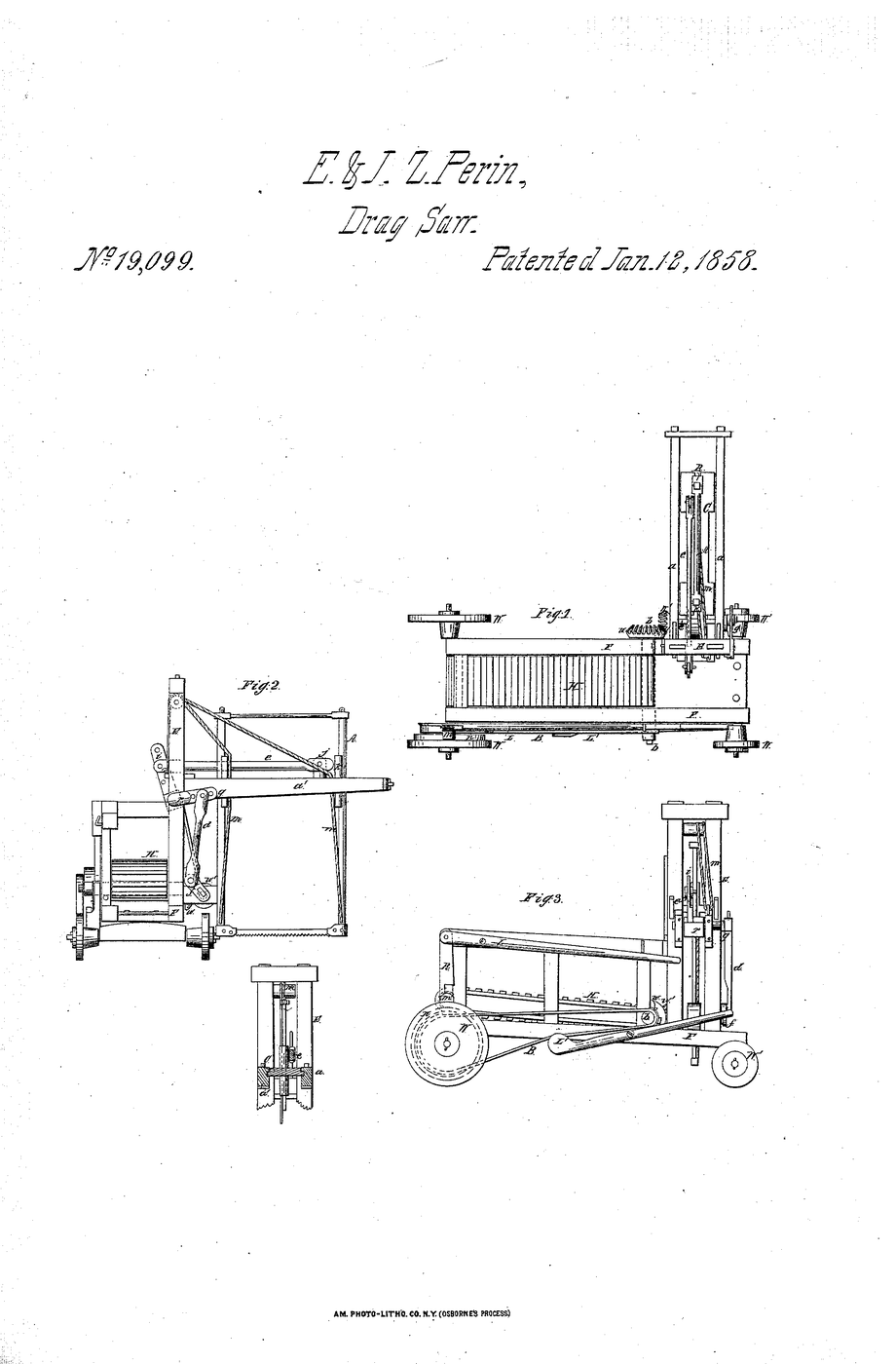
John Z. was almost certainly Ezra’s eldest son, John Zimri Perin, born 25 March 1840. If so, he was seventeen when the patent was issued, a co-inventor with his father. The patent itself does not say they were father and son; the names, the town and the dates do.
A roller and seed planter, 1866
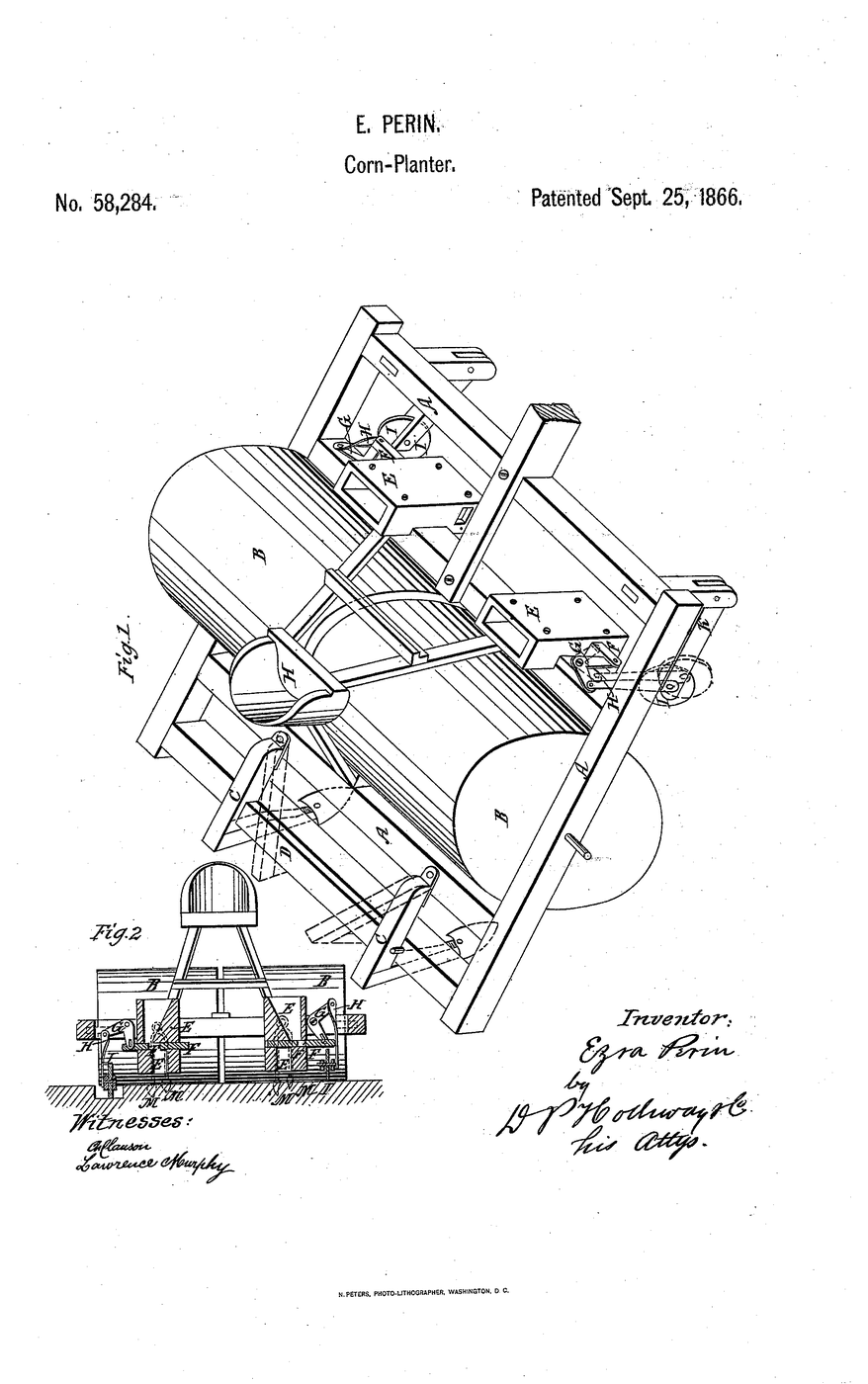
Patent 58,284, dated 25 September 1866, was granted to Ezra Perin of Connersville for an Improvement in roller and seed-planter combined: large wooden rollers on a frame, with a mechanism that dropped the corn, covered it and pressed the soil down in one pass across the field. Seen in records
The one he gave up
The family also remembered that Ezra had the idea of an electric motor, long before anyone made money from one. On New Year’s Day 1885, writing from Andersonville to his son Charles and Charles’s new wife Geraldine, Ezra told the story himself. Grandpa keeps the letter on his blog.
Decades earlier, he wrote, he had sent a design for an electrical machine to Munn and Company, the patent agents in New York who published Scientific American. They told him that his machine would run, but that electricity could never be used as a motive power.
I gave up at once, as I thought they knew.
Ezra Perin to Charles and Geraldine Perin, 1 January 1885
He compared himself to the servant in the parable of the talents who buried his talent instead of using it, and said that only God knew what might have come of it if he had kept going. Seen in records
The patents prove two of his machines. They do not prove the electric motor, or the airplane and powered sled that later family stories add, and nothing yet does. What the letter proves is that he had the idea, sent it to the right people, and was told no.
What he told his son
The rest of the letter is advice to a young man starting out, and it reads like a father who did not want his son to make his mistake. Choose a worthwhile cause and keep at it, he told Charles, and “your name will go down to posterity, enveloped in a halo of blessings and praise.” Keep a scrapbook. Always carry a notebook and write down any useful thought before it goes. Read the story of Abraham; learn the ninety-first Psalm by heart. He signed it “affectionate Father,” and mentioned that he was getting over a bad cold.
A family history is a kind of scrapbook. He would probably have approved.
The violins
Stanley wrote that Ezra also made violins, handsome to look at but without much tone, and that one of them belonged to Arthur. Family account, Stanley E. Perin

This photograph is on Grandpa’s blog and could not be shown just now. See the Six Violins page.
Ezra and Phoebe’s children
Glover lists ten: John Zimri, Emily Diantha, Laura Peel, B. Franklin, Samuel Ezra, Susan E., George Nelson, Lucinda Jane, George, and Charles. Several died young; a second George after the first suggests one of them. Charles, our line, was the youngest, born twenty years after his eldest brother. Published genealogy
Emily Diantha married Hiram Tucker and outlived him. She died at Anderson, Indiana, on 23 January 1906, at sixty-four, and the Anderson Herald announced it the next day under the heading “Angel of Death”; a cousin’s transcription of the notice is in Grandpa’s database. Family chart
The eldest’s middle name is a small clue worth noticing. Phoebe’s father, according to Grandpa’s chart, was Zimri Utter. John Zimri Perin was very probably named for his grandfather. Chapter five follows the Utters.
Grandpa’s chart gives Ezra’s death as 1902, and his database, drawing on FamilySearch, gives the day: 22 July 1902, at Columbia in Fayette County, Indiana, where he was buried. Family chart Another family account gives a different year, and the record that would settle it, a gravestone or death notice, has not been found yet.