Cousins in the record
Off the direct line, the family produced a governor, a surgeon general’s officer with a passion for genealogy, and a postmistress whose letters survive.
The governor
Ezra Perin’s sister Hannah, born in 1809, married three times. Her second husband was Benjamin Warren Savage, and on 3 April 1842 at Connersville, Indiana, she had a son named Ezra Perin Savage. Ezra was also the name of her brother, our Ezra; nothing we have found says which Ezra, if either, the boy was named for. Published genealogy
The family soon moved west to Iowa. Ezra Savage studied law, was admitted to the bar in 1875, moved to Nebraska in 1879 and founded the town of Sargent in Custer County. He was mayor of South Omaha, then lieutenant governor, and when Governor Charles Dietrich resigned on 1 May 1901, Ezra Perin Savage became governor of Nebraska. He served until 8 January 1903. Published genealogy
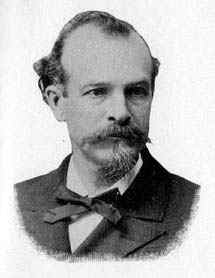
This portrait is kept by the National Governors Association and could not be shown just now. See it at the source.
His time in office is remembered mainly for one decision. He paroled and then pardoned Joseph Bartley, a former state treasurer convicted over missing state funds, and the criticism cost him his political future. A family history can hold an accomplished relative and an unpopular decision in the same paragraph. He died on 8 January 1920 and is buried at Tacoma, Washington.
How we know he is ours: a historical Biographical Dictionary of America names his parents as Benjamin Warren Savage and Hannah Perin, and his grandparents as John Perin and Rachel Rice. That matches Glover’s entry for Hannah exactly. The governor was a first cousin of Charles Rice Perin, and Grandpa’s first cousin twice removed.
He left papers. History Nebraska holds about six hundred items from his time as governor, including a file labelled “Savage Family, 1901,” the year he took office and relatives might well have written to congratulate him. A request for that file has been sent; see the quest.
The cousin who wrote the book
Glover Perin, born 17 November 1823, was the son of Samuel of Perin’s Mills, and so a first cousin of Ezra. He became an army surgeon and rose to Assistant Surgeon General of the United States Army. In June 1885, at Fort Snelling, Minnesota, he finished the Genealogy of the Perrin Family that almost every later Perin researcher, including this one, has started from. Published genealogy
He was candid about its limits. The preface says it contains “only the names of those I have been able to procure, and is printed at this time with a view of inducing others to carry on the work,” and he left blank pages in it for families to add their own records. This history is, in a small way, what he asked for.
Two collections may give him a face and a voice. The Minnesota Historical Society holds his papers from 1851 to 1918, including personal letters from 1882 and letters about his use of the agave plant against scurvy while stationed in Texas. Michigan State University’s archives list a photograph of him among the papers of John Gibson Parkhurst. Requests have gone to both.
The postmistress of Clyde
Jesse Perrin had a son Asa, a younger brother of Lemuel, who went to Ohio. Asa’s son Zelotes, born in 1826, married Floria or Flavia Gray in 1848 and lived at Clyde, Ohio. Published genealogy The Indiana Historical Society’s catalogue adds that she was the town’s postmistress.
Their letters survive. The Indiana Historical Society holds correspondence from Flavia and Zelotes Perin, 1863 to 1896, among the papers of her Gray relatives: everyday family news, illnesses, the ordinary weather of a family’s life. Zelotes was a first cousin of John Perin the builder, though born fifty years after him. These letters are the likeliest place to hear the nineteenth-century family speak for itself, and a request for them has been sent.
The Roxbury Perrins
The second John’s son Noah, a brother of our third John, settled at Roxbury, then a town of its own outside Boston, and his descendants became prosperous. A 1910 book, Allied Families of Purdy, Fauconnier, Archer, Perrin, tells their story, and it is full of good anecdotes. They are told here as the book tells them: family traditions written down long after the fact, not events proved in this research. Published genealogy
- Noah Perrin made cloth from the wool of his own sheep in his own mill. His son, also Noah, was Roxbury’s town treasurer for twenty-nine years, a fact Glover’s genealogy records too.
- The lane past the family house was known as Perrin’s Lane until it was given to the town in 1760 and renamed Bartlett Street.
- The younger Noah’s house, the book says, bore the marks of British cannon shot, and under the great elm beside it his wife fed the tired men coming back from Lexington in April 1775.
- A family record claims that the younger Noah’s two sons, John and William, took part in the Boston Tea Party.
- On 25 October 1789, the book says, President Washington attended the baptism of a baby named George Washington Perrin at the Brattle Street Church in Boston. Glover’s genealogy independently gives a George W. Perrin born that same day to Abraham and Rachel Perrin of Boston.
- And in New York in July 1863, during the Draft Riots, Jane Falconer Vogel Perrin watched seven fires from her windows on East Forty-ninth Street, then went out onto her front steps and talked the crowd into moving on.
These are the Perrins of the family’s grander stories. They are cousins, distant ones: their line and ours split between two of the second John’s sons, born in 1668 and 1679.
The cousins who found Grandpa
Some of this family’s cousins arrived by a road Glover could not have imagined. People who had tested their DNA with 23andMe saw Grandpa among their listed relatives and wrote to him, and he worked out with each of them how they are related. His chart follows nine lines, his own among them, back to one man: Lemuel Perin, born at Rehoboth in 1749. Family chart
The lines come down from three of Lemuel’s children.
| Lemuel’s child | How the line runs, as the cousins’ trees give it | Cousins |
|---|---|---|
| John, 1774–1866 our line | Through Ezra and his son John Zimri (1840–1908) to Edith Grace Perin (1881–1939), who married Charles T. Myers; and through Ezra and Charles to Grandpa’s aunt Una Cleone Perin, born in 1900, who married Forrest F. Scott. | 2 |
| Lucy, 1779–1836 John’s full sister | She married Ezra Carpenter. Their daughter Esther married Andrew Coryell, and the line runs on through the Lamkin, Buttrick and Hill families. | 1 |
| Glover, 1795–1851 John’s half-brother | One of the twins Lemuel had with Amelia Dickinson. He married Sally Smith, and the lines run through two of their sons: Lemuel (1820–1853), whose descendants kept the Perin name, and Barnette (1818–1890), whose daughter Arilla married into the Newberry family. | 5 |
This is a different kind of evidence from everything else in this history. The other chapters rest on paper: Glover’s book, the county histories, the town records. Paper can copy a mistake from an older book; DNA cannot. A match does not say by itself which ancestor two people share, which is what the family trees are for, and it is why several families who did not know each other arriving at the same man counts for far more than any one of them.
The five on Glover’s line count for the most. Glover was John’s half-brother, born to Lemuel’s second wife, so in that generation his descendants and Grandpa have exactly one ancestor in common: Lemuel himself. Lucy’s line, through Lemuel and Martha together, points the same way. Between them they give the step from Lemuel to our John a kind of support that no book could.
The match through John Zimri adds weight to a link this history still marks as probable: that the John Z. Perin who shared Ezra’s 1858 patent was his son. A cousin who descends from John Zimri and shares DNA with Grandpa is most simply explained that way. The mark stays where it is until a record names them together.
The chart was compiled from what each cousin sent. Their trees have not been checked against records here, and the living cousins on it are not named in this history.