The arms, England and France
Earlier family historians pointed to an English pedigree and a coat of arms. We went and read the pages they cited.
The arms
Glover’s genealogy opens with a coat of arms. In the 1885 preface he pointed readers to the pedigree of “Perrin of Ashby de la Zouche” printed in John Nichols’s history of Leicestershire, and described its arms. For a century afterwards the family’s English origin was told as the story of that pedigree.
The arms are real. The heralds who toured Leicestershire in 1619 recorded them for the Perin family of Ashby de la Zouch, and the 1870 printed edition of their visitation gives them in heraldry’s own language:
Argent, on a chevron sable between three pine-apples slipped, reversed vert, as many leopards’ faces of the field.
The Visitation of the County of Leicester in the Year 1619, Harleian Society, 1870, page 198
In plain words: a silver shield; across it a black chevron, the shape of an upside-down V, carrying three silver leopards’ faces; and around it three green pine cones on their stalks. A “pine-apple” in old heraldry is a pine cone, not the tropical fruit. Seen in records
The printed edition gives the shield alone, and this history once said the visitation recorded no crest. The manuscript says otherwise. In the British Library’s seventeenth-century copy of the visitation, Harley MS 1189, folio 95, the copyist drew the arms in ink and marked the colours with letters, and above the shield he drew a crest: a pine cone marked or, gold, rising from leaves marked v, green, on a wreath. The same drawing shows the three cones on the shield hanging from their stalks, which is what “reversed” means. Seen in records
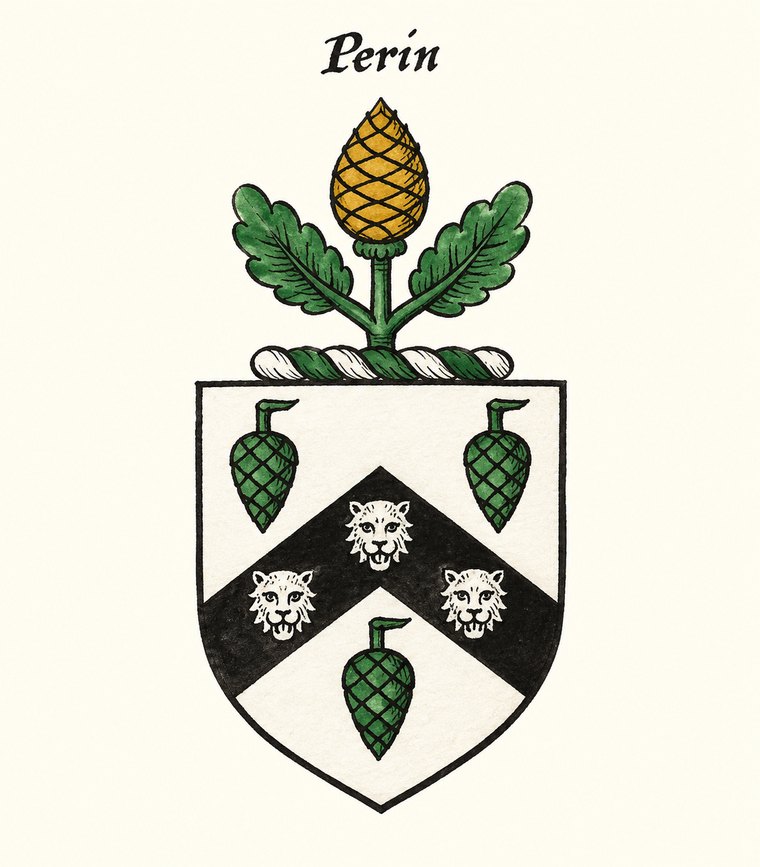
Arms belonged to a particular family, and the right to them passes down a line of descent. Our line runs back, generation by generation, to John Perrin of Rehoboth. The step from John back to Ashby is the one this history went looking for in the records. The first answer from Leicestershire, further down this page, points the other way.
What the Ashby pedigree actually says
We read the pages Glover cited. Nichols printed the Ashby pedigree in 1804, in volume III of his history of Leicestershire, page 633; the University of Leicester has scanned it.

This page is kept by the University of Leicester and could not be shown just now. See it at the source.
It shows three generations:
- Gilbert Perin, of Shropshire, who married Elizabeth, daughter of a Scrimshawe of Shropshire;
- their son Thomas Perin, of Ashby de la Zouch, who married Katharine, daughter of Thomas Parrett of Ashby;
- their son Thomas Perin, aged thirty-four, who married Anne, daughter of Ralph Potter of Lichfield, with a son Thomas and four daughters: Katharine, Elizabeth, Sarah and Mary.
Our John does not appear on this page, and it mentions no French birthplace, no Huguenots and no one crossing to Massachusetts. It records an English family with these arms and stops there. Whether John belongs to that family, as a younger son or a cousin the heralds never wrote in, is a question this page cannot settle either way. The Leicestershire records may.
The heralds’ own record, in the 1870 edition of the visitation, agrees on the family but differs from Nichols on two numbers, and its version makes better sense: the year is 1619 rather than 1629, and the son Thomas was nine rather than nineteen. A father of thirty-four with a son of nineteen was always a puzzle.
The manuscript itself settles it. Folio 95 of Harley MS 1189 gives the son Thomas as “filius & heres,” son and heir, aged nine, with Katharine aged eight, Elizabeth six, Sara three, and Mary three months, the entry dated 8 September 1619. It places Elizabeth Scrimshaw’s family in Staffordshire, where Nichols has Shropshire. And it names no John. Seen in records

This page is kept by the Internet Archive and could not be shown just now. See it at the source.
If our John was born in 1614, he would have been about five when the heralds came, and a five-year-old second son would normally be listed. His absence is not proof that he was not theirs, since pedigrees do leave people out, but it is a real problem for every online tree that makes him the son of Thomas Perin and Anne Potter.
How a question became a fact
So where does “1614” come from? From a passenger list. In August 1635 a ship called the Safety, John Graunt master, was cleared at London to carry passengers to Virginia. Among them was “John Perryn, 21.”

This page is kept by the Internet Archive and could not be shown just now. See it at the source.
In 1878 a researcher named Edward F. Everett noticed him and asked, in print, the right question:
Was he the John Perrin, Sen., of Braintree and Rehoboth?
Edward F. Everett, New England Historical and Genealogical Register, volume 32, October 1878, page 424
Seven years later Glover’s genealogy answered it as though it had always been settled: John Perryn, aged twenty-one, “came from London, England, to Braintree, Mass., Aug. 10, 1635, in ship ‘Safety.’” The ship’s papers say Virginia, not Braintree. Nobody has yet found the record that would connect the young man on the Safety to the settler at Rehoboth. He may be our John. He may not.
That small slide, from Everett’s question to Glover’s certainty, is how a great deal of family history is made, and it is worth knowing about. The honest version of the first John is shorter: he was at Braintree by 1640, his birth year is unknown, and his English parents are unknown.
The best lead in England
A calendar of Leicestershire wills, published in 1902, lists a probate in 1624 for “Perins, Thos.; Ashby Delazouch,” number 66 of that year.

This page is kept by the Internet Archive and could not be shown just now. See it at the source.
If this is the Thomas who was thirty-four in 1619, he died at about thirty-nine with young children, and a man in that position often named his children and their guardians. A son John in that document would be the first record ever to tie our immigrant to Ashby. Children named with no John would count strongly against it. Either way the question would move.
The question has moved. In October 2026 James Stevenson, an archivist at the Record Office for Leicestershire, Leicester and Rutland, looked at the original for this history. It is a will, a single sheet, and the testator, Thomas Peryns, names four children: two sons, Thomas and Symon, and two daughters, Katherine and Mary.
That is plainly the family the heralds met five years before. The son Thomas, Katharine and Mary are all in the 1619 pedigree; Symon was very likely born after it. And there is no John. A father setting his affairs in order usually names his children, and a son of about ten would be among the last to be left out. It does not prove that our John came from somewhere else. A will can leave out a child already provided for, and a careful family history says “counts strongly against” rather than “disproves.” But it is the record this history said would settle the most, and it points away from Thomas and Anne as John’s parents.
That leaves the question open in a better place than before. Somewhere there is a record of where John Perrin of Rehoboth was born and who his parents were, and the online trees that made him Thomas and Anne’s son had simply stopped looking. The Ashby parish registers are still worth searching for other Perin families, and the archivist pointed out that Anne Potter’s marriage would most likely be found in her own parish, at Lichfield in Staffordshire. A copy of the will has yet to be ordered; it will be added here.
None of this would have surprised the family’s own historians. Grandpa’s uncle Stanley declined to connect the Ashby family, or the Huguenot line, to our branch, and Grandpa has always held both as open questions. Grandpa’s own account, October 2026
Two other Johns to keep apart
- A John Perrin was a freeholder at Houghton-on-the-Hill, Leicestershire, in 1630, and a “John Justice alias Perrin” of Houghton had his estate proved in 1638. If they are the same man, he died long before our John, who died in 1674.
- A John Perrin of Stansted Mountfitchet, Essex, was indicted in 1684 for attending an unlawful religious meeting. He cannot be ours either: ours had died ten years earlier.
The 1910 Allied Families book says the first John was born at Chelmsford, Essex. It gives no source, and none has been found.
France
The family has a tradition that it was French in origin: a Protestant or political rupture in France, a branch that went to England, and another connected with the Huguenots and Maryland. That tradition belongs in this history in its own words, and it stays here as a tradition until the generations connecting it to John can be shown.
A few things can be said. The great Huguenot flight from France came after 1685, when John had been dead eleven years, so it cannot explain his family; an earlier Protestant migration to England is possible but not shown. Glover himself took the crest he printed, “a pineapple, vert,” from “a certain Perrin, made baron in 1805,” and never explained how that man was related. “Pineapple” was the old word for a pine cone, so his green cone is a near relation of the gold one the 1619 manuscript draws among green leaves.
The research has turned up real French Perrins worth knowing about, none of them yet connected to us. Alexis de Perrin, lord of Montpinier in Languedoc, was called a rebel in an order of September 1622, and his castle was handed to the consuls of nearby Lautrec. A family called Perrin de la Bessière has a manuscript genealogy in the library at Châlons-en-Champagne. Daniel Perrin, “the Huguenot,” settled in New Jersey and on Staten Island, and his descendants are a different American family from ours.
The most promising door is in London. The Huguenot Society’s library keeps research files on families by surname, and it has one for Perrin and one for Perren. Earlier researchers may already have tested exactly this tradition. A request has been sent.